
Direct vs Indirect Communication – How to Navigate Them in International Business
In today’s globalized business environment, effective communication is one of the most critical skills for international success. Yet, what seems like clear and straightforward communication in one culture can be perceived as rude, vague, or even misleading in another. Understanding the difference between direct and indirect communication styles is therefore essential for anyone working in cross-cultural business, export, international sales, or multicultural teams.
Why Communication Styles Matter in Global Business
When companies expand into new markets, they often focus on product fit, pricing, logistics, and legal structures. However, cultural differences in communication are frequently underestimated — even though they can be the deciding factor between a successful partnership and a failed negotiation.
Misunderstandings in communication can lead to:
- damaged relationships
- failed negotiations
- lost trust
- missed opportunities
- and unnecessary conflicts within international teams
This is why intercultural communication is a core focus area in EYBA’s programs. We have seen that even strong products and well-prepared strategies can struggle if communication does not align with cultural expectations.
The Origins of Direct and Indirect Communication
The distinction between direct and indirect communication styles was first popularized by scholars such as Edward T. Hall, a pioneer in intercultural communication studies. His research highlighted how different cultures rely on words versus context when conveying meaning.
In simple terms:
- Direct communication cultures rely primarily on spoken or written words.
- Indirect communication cultures rely more on context, relationships, tone, and non-verbal cues.
As Hall famously suggested:
“Sometimes words are the same, but meanings can vary depending on culture and context.”
What Is Direct Communication?
Direct communication is common in countries such as:
- United States
- Canada
- Germany
- Netherlands
- Nordic countries
In these cultures, communication is typically built around clarity and openness: people aim to be explicit in their expression, comfortable with addressing issues directly, and oriented toward efficiency and transparency in professional interactions — which is reflected in the way they tend to:
- speak clearly and explicitly
- say what they mean
- address issues openly
- value transparency and efficiency
- and prefer straightforward feedback
For example, a direct communicator might say:
“This proposal does not work for us. We need to revise it.”
From their perspective, this is professional and constructive. However, in some cultures, such directness might be perceived as harsh or disrespectful.
Strengths of Direct Communication:
✅ clarity
✅ efficiency
✅ reduced ambiguity
✅ faster decision-making
Potential Risks:
⚠️ can be perceived as rude or insensitive
⚠️ may damage relationships in more relationship-oriented cultures
⚠️ may feel confrontational
What Is Indirect Communication?
Indirect communication is more common in cultures such as:
- Japan
- China
- South Korea
- Middle Eastern countries
- many parts of Latin America
In these cultures, communication is often shaped by context, relationships, and a desire to maintain social harmony: people tend to be more subtle in their expression, sensitive to interpersonal dynamics, and mindful of preserving face and mutual respect — which is reflected in the way they often:
- avoid direct confrontation
- prioritize harmony and relationships
- communicate through hints, tone, and context
- expect the listener to “read between the lines”
For example, instead of saying “No,” an indirect communicator might say:
“That might be challenging at the moment.”
The meaning is clear within the cultural context — but only if you understand how to interpret it.
Strengths of Indirect Communication:
✅ preserves relationships
✅ avoids conflict
✅ shows respect and sensitivity
✅ builds long-term trust
Potential Risks:
⚠️ can be misunderstood by direct communicators
⚠️ decisions may take longer
⚠️ expectations may remain unclear
How to Navigate These Differences in Business
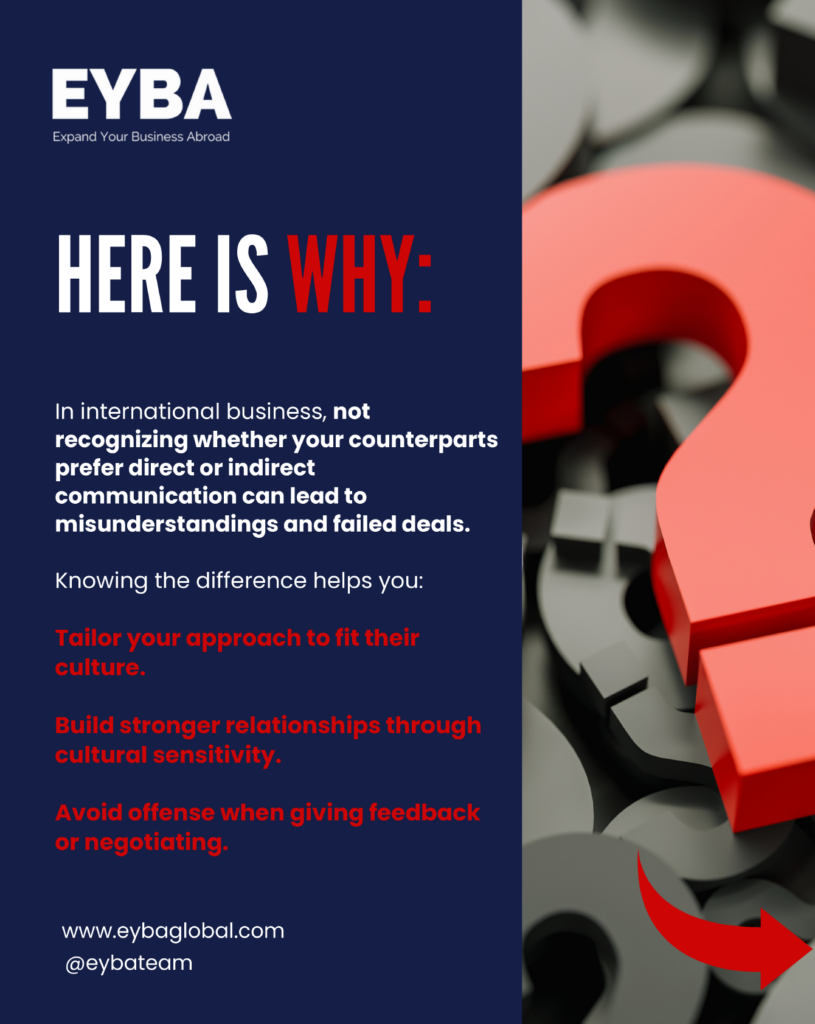
Being aware of these styles is not about labeling one as “better” than the other — but about adapting your approach to the cultural context.
Here are three key principles for navigating direct and indirect communication effectively:
- Tailor your approach to the culture
Before entering a new market or negotiating with international partners, research their communication style and adjust accordingly. - Build stronger relationships through cultural sensitivity
In indirect cultures, invest more time in relationship-building before jumping into business discussions. - Be mindful when giving feedback or negotiating
In direct cultures, be clear and structured. In indirect cultures, frame feedback more diplomatically and respectfully.
How EYBA Applies This in Real Business Situations
At EYBA, we work closely with export managers, founders, and international sales teams who operate across multiple cultures. We help them:
- recognize different communication styles
- adapt their negotiation tactics
- improve cross-cultural collaboration
- and avoid costly misunderstandings
Understanding communication styles helps our participants:
✅ build trust faster
✅ improve negotiation outcomes
✅ create stronger long-term partnerships
Want to Explore This Topic Further?
We have created a practical guide that expands on this article with real-life examples from different cultures, typical international sales scenarios, and actionable tips for export managers and global teams.
📄 Free downloadable PDF:
Direct vs Indirect Communication – Practical Guide for Cross-Cultural Business
Inside the guide you will find:
- real-life communication examples from different cultures
- typical scenarios in international sales and negotiations
- tips to avoid misunderstandings
- practical guidance for export managers and global teams
👉 This resource is ideal for exporters, international leaders, and multicultural teams who want to strengthen their communication competence.
🔽 Download the full guide here:
[EYBA – Direct vs indirect communication – How to navigate them]
Final Thoughts
In international business, success is not just about having the right product or strategy — it is also about understanding people. By becoming more aware of direct and indirect communication styles, you become a more effective global communicator, negotiator, and leader.
At EYBA, our mission is to simplify international expansion — and mastering cross-cultural communication is a crucial part of that journey.